 Skip to main content Skip to footer
Electrician for Leeds City Centre Flats and Apartment Blocks
Inside the Inner Ring Road, most of our work is in buildings rather than houses. Flat EICRs for leaseholders and letting agents, fixed wire testing of landlord's supplies and communal areas for freeholders and management companies, riser and plant room work, emergency lighting and door entry. We work around concierges, service lifts, permit bays and sleeping residents, and we tell you the price before the first board comes off.

Standard
Building Regs
Inspection & Testing
BS 7671
Public Liability
Flats and Blocks
Eight in Ten Homes Here Are Flats in a Block
Every other area page on this site is about houses. This one is not, and the Census makes that unarguable. In the city centre core, 80.9% of homes are purpose-built flats against 17.5% across Leeds. Another 11.4% sit in converted buildings, which here usually means a mill or an old office block turned into apartments.
Tenure is just as lopsided. 71.0% of city centre homes are privately rented against 21.8% across Leeds, and only 19.4% are owner-occupied against 57.0%. Just 6.2% are owned outright.
So the person who rings us about a city centre electrical problem is usually not the person living with it. It is a block manager, a management company, an RMC director, a freeholder or a letting agent. That changes the job from the first phone call: there is a demise boundary to work out, a service charge to answer to, residents to notify, and often a concierge who decides whether we get in at all.
One Flat's EICR Is Not the Block's Fixed Wire Test
This is the question we get asked most in LS1 and LS2, and the one nobody local has bothered to answer properly. People assume that if the block has been tested their flat is covered, or that testing every flat means the building is done. Neither is true. They are two separate installations, commissioned by two different people, ending in two different certificates.
Draw the line at the meter or the tails serving the flat. Everything on the flat side belongs to whoever holds the lease. Everything on the other side, the risers, the landlord's supply, the corridor lighting, the plant, belongs to the building.
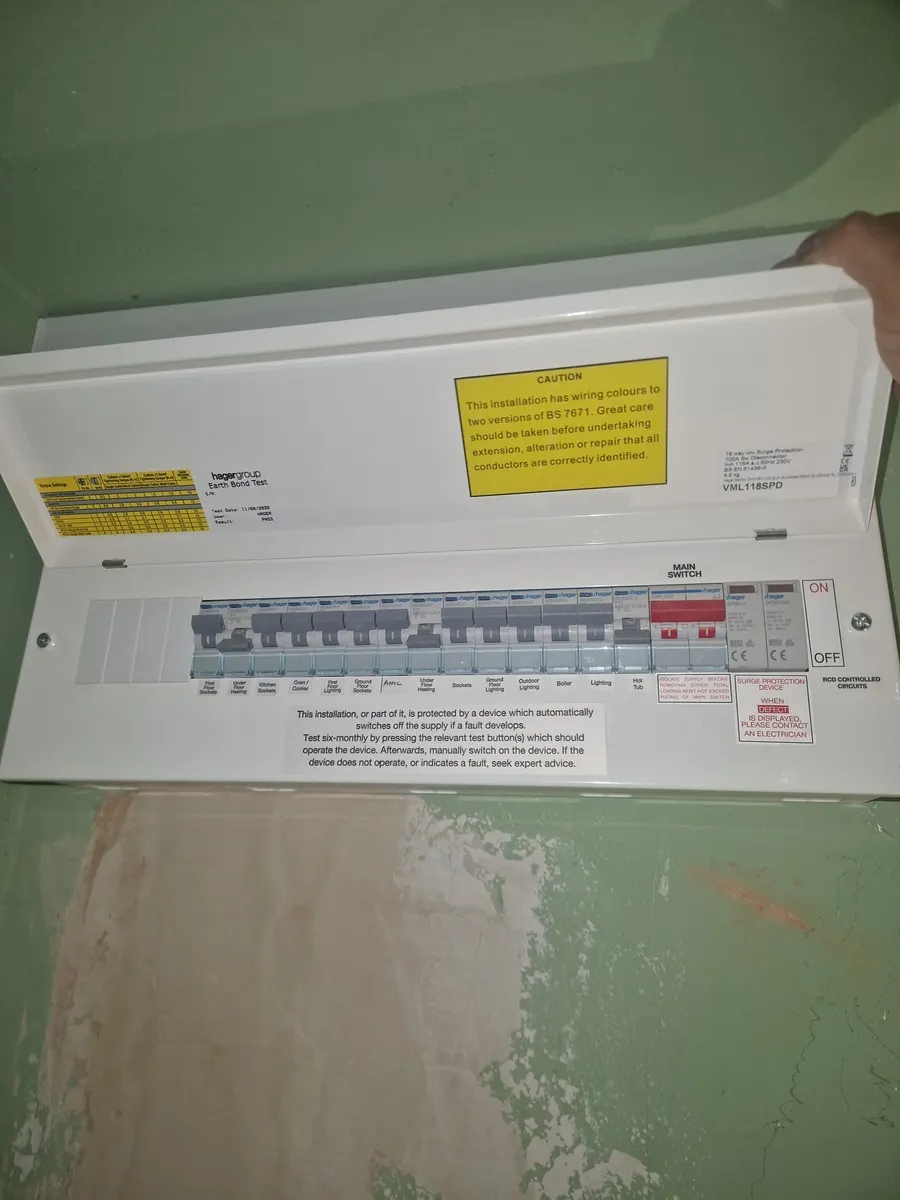
The individual flat EICR
This covers the installation inside the demise: the flat's own consumer unit, its final circuits, sockets, lighting, the shower and cooker points, and any detection wired inside the flat.
- Who commissions it. The leaseholder if they own it, the letting agent or landlord if it is let, and in practice the agent most of the time.
- Why it is done. Where the flat is privately rented, the fixed installation has to be inspected and tested at intervals of no more than five years by a qualified person, under the 2020 Regulations.
- What comes out of it. One EICR for one dwelling, each C1, C2, C3 and FI observation coded and photographed. Tenants get a copy within 28 days, the council within 7 days of asking, and anything unsatisfactory is put right within 28 days.
- How long it takes. A one or two bedroom flat is usually a half day, and we can do several in a building back to back if the agent lines up the keys.
The whole-block fixed wire test
This covers the landlord's installation: the intake, the landlord's supply boards, the rising mains and sub-mains, communal lighting, plant supplies, lift supplies, door entry, car park and bin store power, and the cleaners' sockets nobody remembers.
- Who commissions it. The freeholder, the management company, the RMC or RTM directors, or the managing agent acting for them. Never an individual leaseholder.
- Why it is done. Not under the 2020 Regulations. See the honest explanation below, because this is where most electricians' websites get it wrong.
- What comes out of it. An EICR for the communal installation, usually with a schedule of test results per distribution board, plus separate emergency lighting and fire alarm documentation where those systems are in scope.
- How it is priced. On the number of boards, circuits and communal areas, and on how access is arranged. Not on bedroom counts, which mean nothing here.
That is not the same as saying nobody needs to test them, and the honest answer is more useful than the scary one. The duty arrives indirectly, from three directions:
- The fire risk assessment. Article 9 of the Regulatory Reform (Fire Safety) Order 2005 requires a suitable and sufficient assessment of the risks in the common parts. Electrical ignition sources sit inside that assessment, and a fire risk assessor will often ask to see a current condition report before signing anything off.
- Housing conditions. The Housing Health and Safety Rating System under the Housing Act 2004 includes Hazard 23, Exposure to electricity, and a serious hazard can be enforced against.
- Industry guidance. Electrical Safety First recommends periodic inspection and testing of the communal installation at intervals of no more than five years. A recommendation rather than a statute, and the figure most managing agents and insurers work to.
So the practical position for a Leeds block is this. Test the communal electrics on a five-yearly cycle because your fire risk assessor, your insurer and your leaseholders all expect it, not because a regulation names it. Test the individual let flats every five years because that genuinely is the law. Keep the two sets of paperwork separate, because whoever inherits the compliance file will need to tell them apart.

The Communal Stack, and What Actually Gets Inspected
Ask most electricians what a block EICR involves and you get a shrug and a day rate. Here is the actual list, in the order we normally work through a Leeds block, because knowing it is how you tell a real quote from a guess.
- The intake and the landlord's supply board. Usually in a ground floor cupboard, a basement, or a locked plant room off the car park. This is where the communal installation starts and where the earthing arrangement gets confirmed.
- The rising main and the risers. The vertical spine feeding the flats. We open each riser cupboard on each floor, check the tap-off units, the segregation between services, whether anything has been added since handover, and whether the fire stopping around the penetrations has been disturbed by a previous trade.
- Sub-main distribution. Landing boards, floor boards, and the sub-mains between them. Each one gets its own schedule of test results, which is why board count drives the price.
- Stair and corridor lighting. Including the switching and sensor arrangement, because a corridor that goes dark on a passive infrared sensor with a dead detector is a genuine safety problem rather than a nuisance.
- Plant supplies. Pumps, boosted cold water sets, heat interface systems where fitted, ventilation, smoke shaft fans, gate motors and lift supplies. We test the supply and the isolation. Lift servicing itself is the lift contractor's.
- Door entry and access control. Panel supply, power supply units, batteries, magnetic locks and their fail-safe or fail-secure arrangement, and the interface to the fire alarm where the locks release on alarm.
- Bin stores, car parks, cycle stores and external lighting. The parts most often forgotten and most often found in poor condition, because they are wet, cold, and nobody standing in them is a paying leaseholder.
- Cleaners' sockets and contractor supplies. Small, unglamorous, and the single most likely thing in a block to be feeding an extension lead that has been there for six years.
Emergency Lighting and Fire Alarm Interfaces in a Block
These are the two systems that turn a block from a set of flats into a building with a duty attached, and they run on a different rhythm from everything else. A five-yearly EICR does not cover them. They need a routine.
Emergency lighting to BS 5266
Escape routes, stair cores, lobbies and plant rooms need illumination that survives a mains failure. The maintenance regime is the part people underestimate:
- A monthly function test, short, confirming each luminaire strikes on its own battery, logged.
- An annual full duration test, running the system for its rated duration, commonly three hours, then confirming full recharge. This is the test that finds the fittings quietly dead for two years.
- A written log a fire risk assessor or insurer can actually read. We leave it in the building, not in our van.
- Battery and lamp replacement handled as it comes up, rather than as one expensive failure at the next inspection.
Article 17 of the Fire Safety Order requires fire safety facilities, including alarms and emergency lighting, to be maintained in efficient working order and in good repair. That is a real and enforceable duty. What it is not is a duty to periodically test the communal power installation. Two separate obligations, and conflating them is how blocks end up paying for the wrong thing.
Fire alarm interfaces, BS 5839-1
Detection design in a purpose-built block follows the building's fire strategy and it is not our job to overrule it. What is our job is everything the alarm talks to:
- Magnetic door holders and releases that drop the doors on activation.
- Automatic opening vents and smoke shaft controls, and the supplies feeding them.
- Lift homing, bringing cars to the designated floor and parking them with doors open.
- Plant shutdown, dropping ventilation and other equipment on alarm.
- Access control release, so a maglock on an escape route unlocks rather than trapping people behind it.
We test those interfaces on the same visit and record them, because one isolated during an old repair and never put back only shows up when it matters.
Where the Leaseholder Stops and the Freeholder Starts
A fault in a riser and a fault inside a flat are not the same conversation, even when they produce the same symptom on the same evening. The difference is the demise, which is simply the part of the building your lease gives you. Every lease is different and yours is the one that decides it, so read it or ask your managing agent. That said, city centre leases in Leeds tend to draw the line in much the same place:
Usually inside the demise
- The flat's consumer unit and everything downstream of it.
- Sockets, switches, light fittings and their final circuits inside the flat.
- The shower, cooker and immersion circuits serving that flat only.
- Smoke and heat detection wired within the flat, where it is not part of a building-wide system.
- The flat's own meter tails in many, though not all, leases.
Usually the landlord's, paid through the service charge
- The intake, the landlord's supply boards and the rising mains.
- Everything inside the riser cupboards, including the tap-off feeding your flat.
- Corridor, stair, lobby, car park and external lighting.
- Door entry, access control and the fire alarm system in the common parts.
- Lift, pump, ventilation and other plant supplies.
The practical consequence is worth spelling out. If your flat has lost power and the neighbours are fine, that is almost always inside your demise and it is your electrician to call. If several flats on the same stack have gone, or the corridor lights are out too, it is the landlord's installation and the call goes to the managing agent. Ringing the wrong one costs a day and sometimes a wasted call-out charge. We will tell you which side of the line a fault sits on before we take the work, even where that means telling a leaseholder the job is not theirs to pay for.
Section 20, and why a block job is not a same-day decision
Here is a piece of leasehold law that catches out first-time RMC directors and that no competing electrician in this city has written about. Under Section 20 of the Landlord and Tenant Act 1985, a landlord has to consult leaseholders before certain spending:
- Qualifying works, where any one leaseholder's contribution would come to more than £250.
- Qualifying long-term agreements, meaning any agreement running longer than 12 months, where any one leaseholder would contribute more than £100 in a year. A rolling maintenance contract for emergency lighting or door entry crosses that line easily.
- Thirty days for leaseholders to make observations, which the landlord must have regard to, and a right for leaseholders to nominate a contractor the landlord is then obliged to approach.
Get the consultation wrong and recovery through the service charge can be capped at those figures, which is a painful outcome for a director who was only trying to get the corridor lights fixed. So we quote block work in a form that goes straight into a Section 20 notice: a clear scope, a fixed figure, and separate pricing for anything optional. If your leaseholders nominate someone else, we are happy to be one of the quotes rather than the only one.
Selective Licensing Does Not Reach the City Centre
Leeds City Council designated its selective licensing scheme on 3 November 2025. It starts on 9 February 2026 and runs for five years. City centre landlords keep being told, by sites that have not actually looked, that they are caught by it. On the evidence, they are not.
We checked this three separate ways: against the council's own indicative street list, against its live published boundary layer, and against control addresses we knew should fall inside. The answer came out the same each time.
- No LS1 or LS2 street appears on the council's list. Briggate, The Headrow, Wellington Street, Boar Lane, Call Lane, Merrion Street, Woodhouse Lane, Vicar Lane, Albion Street and Clay Pit Lane all sit outside the designated boundary.
- The boundary never reaches the river. It runs along the M621 and the railway corridor beside it, stopping roughly 900 metres to a kilometre south of the River Aire. The riverside is not in it.
- Leeds Dock is outside. Chadwick Street, Dock Street, Bowman Lane, Meadow Lane and Crown Point Road are all outside the boundary.
- Holbeck and South Bank is outside. Water Lane, Globe Road, Sweet Street and Marshall Street are all outside.
- The city centre end of LS9 is outside. East Street, Marsh Lane and York Street are all outside, and the scheme's nearest point westward is around 700 metres east of Briggate, near St Mary's Street.
The scheme covers parts of Armley, Beeston and Holbeck, Burmantofts and Richmond Hill, Hunslet and Riverside, Gipton and Harehills, and Farnley and Wortley. Note the word parts. It is drawn along roads rather than by postcode, and outcodes like LS10 and LS11 stretch a long way south of anything anyone would call the city centre, which is why a postcode rule of thumb is useless here. Where it does bite, non-compliance carries an unlimited fine or a civil penalty of up to £40,000, so it is worth being certain rather than assuming. Put your actual address into the council's map.
Getting Into a City Centre Building, and Working In It
Half of what makes city centre work different has nothing to do with electricity. It is the twenty minutes before the tools come out and the eighty people asleep above your head. Contractors who only work in the suburbs lose whole mornings to this, and the block pays for those mornings.
The van, and where it goes
- Trade parking in residents' bays is allowed, and this is the useful part. Leeds permits trades to park in residents-only permit zones while working at an address inside that zone, and where under two hours is needed it is free of charge. Regular or longer work should be covered by a dispensation. Permits are virtual and enforcement is by number plate, so the address and the registration have to be right in advance.
- Loading is short. A loading stop is typically limited to around 20 minutes, and it has to be genuinely necessary rather than merely convenient. Board changes and long cable pulls get planned around that, usually by unloading once to a riser cupboard and then moving the van.
- The pedestrianised streets are closed to vehicles mid-day. Briggate, Lands Lane, Commercial Street, Albion Place and lower Albion Street are pedestrianised from 10:30am to 7pm, so vehicle access is outside those hours, and access gates control entry at the top and bottom of Briggate. If your building is on one of those streets, delivering a consumer unit is a scheduling decision rather than an afterthought.
- Skips, scaffolding and containers need their own licence. Scaffolding, cranes and containers need 10 working days' notice, so a job needing them is booked weeks out.
Getting past the front door
- Concierge and fobs. We need a named contact, whether a contractor fob is issued or we sign in, and who holds keys to the riser cupboards, plant room and roof. In our experience the riser keys are the ones nobody can find.
- Service lift booking. Most blocks want the goods lift booked, protected and released by a time. If a lift is out the job changes shape completely, because nothing heavy is going up eighteen floors of stairs on a whim.
- Resident notice. Where testing means isolating a landing board or the corridor lighting, residents need telling in advance. We work to a per-floor schedule so the notice can be specific, and we will draft it for the agent to send.
- Access to individual flats. On a whole-block programme the flats are the bottleneck, not the electrics. Two appointment windows and a clear letter get far better take-up than one date and a threat.
Out of hours here means not waking eighty residents
In a residential block the reason to work outside normal hours is the opposite of the commercial one. It is not about disruption to a business. It is that a block has a quiet window, and drilling into a concrete core at seven in the morning above somebody's bedroom is a complaint the managing agent answers for a fortnight.
So we plan noisy work into the middle of the day, keep evening and early morning visits to quiet tasks like testing and inspection, and treat genuine emergencies as the exception where we come out whenever we are called: a failed landlord's supply, a dead riser feeding several flats, a fire alarm interface that will not reset. Out-of-hours and weekend work is quoted before we attend, so the figure is agreed first and there is no surprise on the service charge.
Flat and Block Prices, Agreed in Writing First
Flat prices are published below because a flat is a predictable job. Block prices are not published, because they honestly cannot be until somebody has counted the boards. Here is exactly how both work.
What We Do in LS1 and LS2
Flat EICRs for Agents and Leaseholders
The five-yearly inspection every privately rented flat needs, coded, photographed and explained. Several flats in one building booked back to back.
EICR detailCommunal and Landlord's Supply Testing
Fixed wire testing of the landlord's installation: intake, risers, sub-mains, corridor lighting, plant and car park supplies, with a schedule per board.
Fixed wire testingEmergency Lighting and Alarm Interfaces
Monthly function tests, annual full duration tests, logs left in the building, plus door holders, vents, lift homing and plant shutdown checked and recorded.
All servicesCommunal Fault Isolation
A dead riser, a failed landlord's supply, a stack of flats off together, corridors in darkness. We isolate safely, get people their power back, then repair.
Emergency helpFlat Consumer Unit Replacement
RCBO boards with surge protection inside the flat, sized for the demise and fitted without touching the landlord's side of the meter.
Consumer unitsDoor Entry, Access Control and Remedials
Panel and power supply faults, maglock release on alarm, plus the remedial work that comes out of an inspection, priced observation by observation.
All servicesThe Quarters and Waterfronts We Work Around
Not one competing city centre page names a single street or development. Here are the places we are actually in. The retail core around Briggate, The Headrow and Kirkgate Market. The bar and apartment blocks along Call Lane and The Calls. Granary Wharf and the canal basin under the Dark Arches. Leeds Dock, which has been renamed twice and which people still call Clarence Dock. The Arena Quarter up by Merrion Way and Clay Pit Lane. Wellington Place and the western edge. Over the river into the South Bank and Holbeck, and out toward Water Lane and Bridgewater Place.
Much of this sits inside a conservation area, and the official names matter when you are writing to the council: Leeds City Centre, Central Area Queen Square, Central Area Canal Wharf, Central Area Eastern Riverside, Grand Quarter, Mabgate, Holbeck, and Woodhouse Lane University Precinct. Inside the Inner Ring Road there are also several hundred listed entries, including the Grade I Town Hall, Corn Exchange, Kirkgate Market, Holy Trinity, Leeds Minster and the Original Infirmary. For a converted building that is listed, external work and anything visible from the street needs consent thinking about early rather than late.
We Leave a Clean Air Zone to Get to Leeds
We are based at 4 Forestdale Way, Shipley, Bradford BD18 1QP, and we would rather say that than pretend to be round the corner from your building. It is roughly 11 to 14 miles, and typically 25 to 45 minutes depending on the hour. Leeds City Council treats the A65 corridor as a congestion hotspot, so we plan around it rather than through it at eight in the morning.
The route is the A657 east through Thackley, Greengates, Apperley Bridge and Calverley to Rodley, then the A6120 Outer Ring Road, then either the A65 Kirkstall Road or the A647 Stanningley Road via Armley Gyratory.
Now the part that is worth knowing if you are comparing quotes. Leeds has no Clean Air Zone. The council decided in October 2020 not to introduce one after a joint review found pollution already below the legal limits. Bradford does have one, an active Class C zone since 26 September 2022, and Shipley sits inside it. So a Shipley-based electrician driving into Leeds is leaving a Clean Air Zone rather than entering one, and there is nothing to charge at the Leeds end. Cars and motorbikes are never charged in the Bradford zone in any case. What that means for you is simple: no zone charge appears anywhere in the price of a job in your building, and our overheads are lower than a city centre operator's.
Twelve Months on Remedials, Five Years on a Board
A report tells a management company what is wrong. What we do afterwards is covered in writing, and the paperwork is written so your compliance file is usable by whoever holds it next.
- 12 months on every remedial, minor works job and fault repair.
- 5 years on full consumer unit upgrades and rewires.
- Reports split cleanly between the communal installation and each individual flat, so nothing gets filed against the wrong installation.
- Emergency lighting logs left in the building, not held on our system where you cannot reach them.
- Fully insured for public liability while we work and afterwards.
- Certificates kept on file: lose a copy and we re-send it free.

33+ Five-Star Reviews on Google
Verified on our Google Business Profile. Quoted verbatim.
"Professional and Solid company. On time, quick and good communication. I Totally recommend it!"
"Excellent service from Leeds Bradford Electricians. Professional, reliable and efficient. Highly recommend for anyone needing a trusted electrician in Leeds or Bradford."
"Very professional, efficient service, good communication.. all very good."
Questions We Get About City Centre Buildings
Does my block legally need an EICR on the communal areas every five years?
Not under the 2020 Regulations, and anyone telling you otherwise is quoting a rule that does not exist. Government guidance published on 1 November 2025 states expressly that those regulations do not apply to communal areas of a building such as stairwells, corridors or other shared spaces. The duty arrives indirectly instead: through the fire risk assessment required by Article 9 of the Fire Safety Order, through the Housing Health and Safety Rating System under the Housing Act 2004, where Hazard 23 is exposure to electricity, and through industry guidance. Electrical Safety First recommends periodic inspection and testing of the communal installation at intervals of no more than five years, and that is the standard most fire risk assessors, insurers and managing agents work to. So test it on a five-yearly cycle, but understand why.
My flat is let. Is that covered by the block's test?
No. They are separate installations with separate certificates. A privately rented flat needs its own EICR at intervals of no more than five years by a qualified person, covering the installation inside the demise: the flat's consumer unit and everything downstream of it. The block's report covers the landlord's installation, meaning the intake, risers, communal lighting and plant. The block certificate does not discharge your obligation, and an enforcement officer will ask for yours.
Who pays, the leaseholder or the freeholder?
It depends which side of the demise the fault sits on, and your lease decides it. As a rule of thumb, the flat's consumer unit and everything downstream of it is the leaseholder's. The intake, risers, corridor and stair lighting, door entry, the fire alarm in the common parts and the plant supplies are the landlord's, recovered through the service charge. A quick test: if your flat has lost power and your neighbours are fine, it is almost certainly yours. If several flats on the same stack are off, or the corridor lights have gone too, it belongs to the building.
Do we need to consult leaseholders before instructing you?
Possibly, under Section 20 of the Landlord and Tenant Act 1985. Consultation is triggered for qualifying works where any one leaseholder's contribution would exceed £250, and for a qualifying long-term agreement, meaning any agreement longer than 12 months, where any one leaseholder would contribute more than £100 in a year. Leaseholders get 30 days to make observations, which you must have regard to, and they can nominate a contractor you are obliged to approach. Getting it wrong can cap what you recover through the service charge. We quote block work in a form that drops straight into a Section 20 notice. Take your own advice on your lease before serving anything.
Does selective licensing apply to a flat in LS1 or LS2?
No. Leeds City Council designated the scheme on 3 November 2025, starting 9 February 2026 for five years, and it does not touch the city centre or the South Bank. We checked it against the council's indicative street list, against its published boundary layer, and against control addresses that should fall inside. Briggate, The Headrow, Wellington Street, Boar Lane, Call Lane, Merrion Street, Woodhouse Lane, Vicar Lane, Albion Street and Clay Pit Lane are all outside. So are Leeds Dock and Holbeck and South Bank. The boundary runs along the M621 and the railway beside it, stopping roughly 900 metres to a kilometre south of the River Aire, so it never reaches the riverside. The scheme starts further out, in parts of Armley, Beeston and Holbeck, Burmantofts and Richmond Hill, Hunslet and Riverside, Gipton and Harehills, and Farnley and Wortley. Check your own address on the council's map, because the boundary follows roads rather than postcodes.
Is a purpose-built block of flats an HMO?
No. Self-contained flats with their own kitchen and bathroom are individual dwellings, however many share a front door. HMO rules are about people in one dwelling sharing facilities, and mandatory HMO licensing applies where five or more occupants in two or more households share a toilet, bathroom or kitchen. What does apply across LS1 and LS2 is the Leeds Article 4 Direction, in force since February 2012, which removes permitted development rights so converting a dwelling into a small HMO needs planning permission. That is planning, not licensing.
How often should emergency lighting be tested in a block?
Monthly and annually. BS 5266 sets out a short monthly function test confirming each luminaire operates on its own battery, and an annual full duration test running the system for its rated duration, commonly three hours, followed by confirmation that the batteries recharge. Both go in a written log kept in the building. Article 17 of the Fire Safety Order requires fire safety facilities, including alarms and emergency lighting, to be maintained in efficient working order and in good repair. What that article does not do is create any duty to periodically test the communal power installation, which is a separate thing.
How do you price a whole block, and how long does it take?
On four things: the number of distribution boards, because each needs its own schedule of test results, the number of circuits across them, which communal areas are in scope including car parks, bin stores and external lighting, and how access is arranged. Bedroom counts are irrelevant. We survey first, then give one fixed written figure before anything is booked, split so optional items can be removed cleanly. Duration depends on access far more than on the electrics, which is why we ask about riser keys and lift booking on the first call.
Where do you park, and can you work around residents?
Leeds permits trades to park in residents-only permit zones while working at an address in that zone, and where under two hours is needed it is free of charge. Longer or regular work should be covered by a dispensation, and because permits are virtual and enforced by number plate we need the address and registration in advance. Loading stops are typically limited to around 20 minutes. On the residents' side, we schedule noisy work into the middle of the day, isolate floor by floor so notices can be specific, and will draft the resident notice for your agent to send.
Are you actually based in Leeds city centre?
No, and we would rather say so. We are at 4 Forestdale Way, Shipley, Bradford BD18 1QP, roughly 11 to 14 miles out and typically 25 to 45 minutes depending on traffic. We work in Leeds most weeks. One thing worth knowing when you compare quotes: Leeds has no Clean Air Zone, and Bradford does, so we are leaving a zone rather than entering one and there is nothing to charge at the Leeds end. Being outside the city keeps our overheads, and your figure, lower than a city centre operator's.
More Reading Around LS1 and LS2
Commercial Electrician in Leeds
For shops, offices, bars, restaurants and salons rather than blocks. Three-phase, fit-outs and managing agent work.
Commercial workFixed Wire Testing in Leeds
How periodic inspection of a larger installation works, what a schedule of test results contains, and how sampling is agreed.
Fixed wire testingEICR Testing in Leeds
What the five-yearly inspection covers in a dwelling, what each observation code means, and what it costs.
EICR LeedsElectrician in Hyde Park
The other side of the university, where the housing is terraces rather than blocks and the calls are reactive repairs.
Hyde ParkElectrician in Headingley
Shared houses and HMO compliance in LS6, which is a different regime entirely from a purpose-built block.
HeadingleyElectrician in Leeds
Our main Leeds page, covering every LS postcode with the full service range and published prices.
Electrician LeedsSend Us the Block Address and We Will Survey It
For a whole block, we need the address, roughly how many flats and boards there are, which communal areas you want in scope and who holds the riser keys. For a single flat, the address and the bedroom count is enough. Either way you get a fixed written figure before anything is booked, and a straight answer about which parts are yours to pay for.